When a person considers the field of specialized medicine, his or her mind is readily swayed towards high profile areas such as cardiology or neurology. Although the heart and the brain are without a doubt essential, General Surgery is the real strength of emergency treatment as well as of preventative medicine in the long term.
At the Ridansh Hospital in Lucknow, we are able to observe how the word General may be slightly misused. Contrary to being a jack-of-all-trades, the general surgeons are extremely specialized specialists who are concerned with the complexities of the abdominal cavity, the digestive organization, the endocrine system, and the soft tissues. It is not only a matter of medical curiosity: a knowledge of when to refer to a general surgeon may save a life or result in a crisis based on whether red flags are recognized or not.
The reason General Surgery is the Silent Engine of Medicine
General surgery can be referred to as the restoration of functionality before failure in a system takes place. In a busy city such as Lucknow where the changing lifestyle and food habits are quickly changing, the rate of abdominal and digestive complications is increasing.
The Center of Emergency Care: The majority of surgical emergencies that present themselves in the ER of a given hospital, such as acute trauma or internal infections of sudden onset, are the domain of the general surgical team.
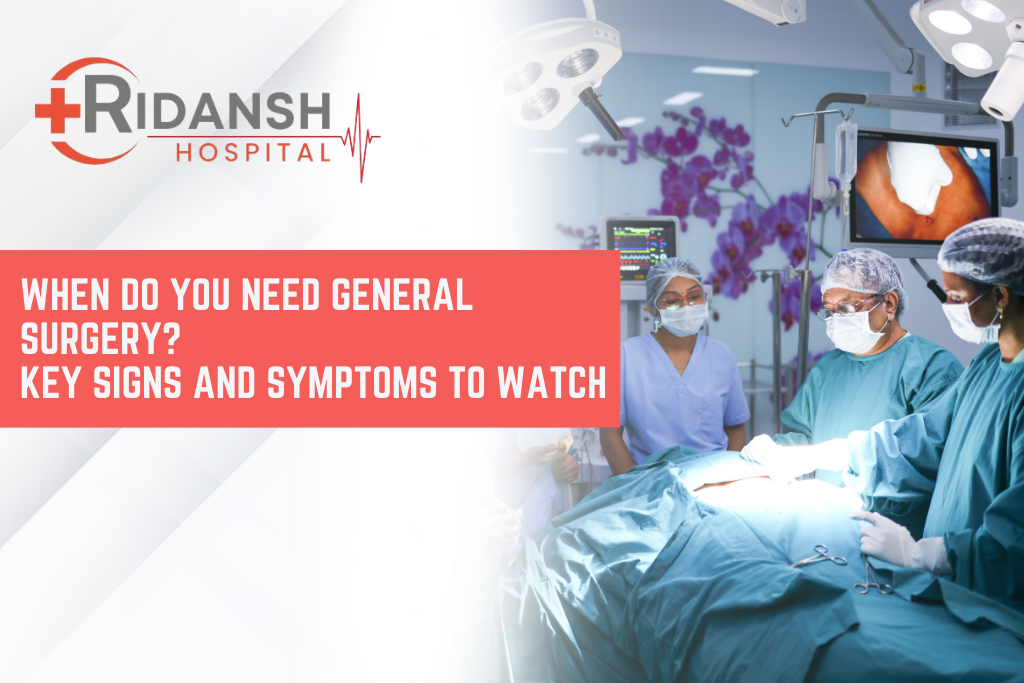
The Magic of Minimally Invasive Procedures: Say goodbye to the era of protracted post-operative periods and huge scars. Laparoscopy is of primary importance in modern general surgery as is the case of Ridansh. Surgeons can make intricate repairs with the least amount of blood loss and a significantly higher rate of discharge by use of cameras and special equipment using incisions so small only the size of a fingernail.
Avoiding the so-called Chain of Escalation: A minor hernia or a complaining gallbladder may be perceived as a minor inconvenience nowadays. Nevertheless, general surgery is intended to prevent the development of these problems to the point of strangulation or systemic sepsis.
How to know: Important Signs and Symptoms When Your Body is Trying to talk to you!
The body is so expressive. In case one of the internal organs is in distress, it gives certain distress signals. Early identification of these will avoid the necessity of having an open operation and swifter healing.
Severe pain in the Lower Right Abdomen (Appendicitis)
The appendix is a little pouch but on the occasion when it gets inflamed it is a time bomb. This typical course begins with a dull pain around the belly button which then starts to travel or move to the lower part of the right side that becomes sharp and very severe. This should be examined by surgery immediately in case it is accompanied by a low-grade fever or lack of appetite.
Several hours after heavy meals or fatty food, a person is experiencing pain in the stomach area.
When you have been eating and someone stabs you in the upper right abdomen, or even under your shoulder blade on your right side, then your gallbladder could be the cause. Bile ducts may be blocked by the presence of gallstones, which causes inflammation (cholecystitis). Otherwise, this may result into serious infections or pancreatitis.
An Obvious or Tangible Protrusion (Hernia)
A hernia is the protrusion of a body part or body fat through a lapse of a local muscle or connecting tissue. You may experience a lump in the abdomen or groin which is worseened in response to coughing, strain, and lift heavy objects. Although some of them are painless, a hernia which gets stuck (incarcerated) may cut off its blood supply and turn into a surgical crisis in a matter of hours.
Continuous Nausea and Gastric Inability to Pass (Bowel Obstruction)
A bowel obstruction may occur in case of excessive bloating, cramping and inability to pass a bowel movement or release gas. It can either be occasioned by scar tissue of previous surgeries, hernias, or tumours. Such is an acute case that requires immediate diagnostic skills of a general surgeon.
Jaundice: Yellow Eyes or Skin
When you start to yellow up on the skin or the whites of the eyes then you know that your system is accumulating bilirubin. This is usually an indicator of an obstruction in the duct of bile or a problem with the pancreas. These pathways are complex and thus, a general surgeon might have to step in and de-block them to restore normal liver and pancreatic functions.
Chronic Cardiac Heartburn or Acid Reflux
Although most individuals use over-the-counter antacids as a treatment of GERD, in some cases, chronic reflux may also be a symptom of a Hiatal Hernia. The diaphragm may be damaged in the long run by the pushing up of the stomach through the diaphragm. General surgeons are able to perform wraps or repair to provide the natural barrier to stomach acid.
The History of the Surgical Experience
The character of modern medicine has changed to be more proactive than reactive. In Ridansh Hospital, we underline that surgery is not a symptom of failure in the treatment, but an accurate means of solving the problem.
The definition of the surgical experience has changed with the incorporation of the Advanced Laparoscopic Surgery. Patients who may have had a one-week stay in the hospital ten years ago are currently leaving the hospital in 24 to 48 hours. This lowered time out is vital to working population of Lucknow so that they can get back to their daily routine and family duties faster.
Learn to Pay Attention to the Check Engine Light
Chronic pain and acute illness are often fixed in the last resort by general surgery. The symptoms of the abdomen or digestive tract do not just vanish by being ignored, they tend to complicate the eventual surgery, increase the size of the incisions and lengthen the process of healing.
In case you have been feeling constant pain in the abdomen, some lumps or sudden alterations in the way your digestive system works, then you do not have to wait until the symptoms become too painful. Health crisis may be a frightening experience but with early consultation with a specialist, it can be transformed into a planned process.